June 22, 2026
Table of Contents:
- What Makes Marine Environment So Destructive to Steel Coatings?
- What are the Main Coating Systems Used for Marine Steel and When is Each Specified
- Coating System Comparison: What to Specify for Marine Steel in UAE
- What Coating Standards Govern Marine Steel Protection in UAE and Gulf Projects?
- What are the Most Common Marine Coating Specification Mistakes on UAE Projects?
- POV: In the UAE's Marine Environment, Coating Specification Conservatism Always Pays Off
- Frequently Asked Questions
- Specifying for Service Life, Not Just Initial Cost
Which Coating System is Best for Steel in Marine Environments: Complete Guide
For steel structures in marine environments, the industry benchmark is a three-coat system consisting of an inorganic zinc silicate primer, high-build epoxy mid-coat, and aliphatic polyurethane topcoat. Submerged and splash-zone steel often requires glass flake epoxy or modified epoxy systems with cathodic protection. The optimal specification depends on exposure zone, design life, and compliance requirements.
Steel structures along the UAE coastline operate in one of the world’s most aggressive corrosion environments. Chloride-laden air, high humidity, intense UV exposure, and wide temperature fluctuations place continuous stress on protective coatings. Facilities such as ports, offshore platforms, marine terminals, and waterfront developments face degradation mechanisms that standard atmospheric coating systems cannot withstand.
Selecting a marine coating system is therefore not a matter of choosing a premium paint product. It requires matching coating chemistry, surface preparation standards, and film thickness to the actual exposure conditions and required design life.
What Makes Marine Environment So Destructive to Steel Coatings?
Marine corrosion is not a single mechanism. Different exposure zones subject steel to distinct combinations of moisture, chlorides, UV radiation, abrasion, and oxygen availability. Each zone requires a coating system designed for those specific conditions.
| Marine Exposure Zone | Environmental Conditions | Primary Degradation Mechanism | Coating Priority |
|---|---|---|---|
| Atmospheric Zone | Salt-laden air, UV exposure, thermal cycling | Chalking, osmotic blistering, gradual film breakdown | UV-stable topcoat and high-build barrier coating |
| Splash Zone | Repeated wet/dry cycling, wave impact, abrasion | Accelerated corrosion and mechanical damage | Tough, high-build coating with strong adhesion |
| Submerged Zone | Continuous seawater exposure | Cathodic disbonding and osmotic blistering | Immersion-grade epoxy with cathodic protection |
| Buried or Soil Interface | Variable moisture, low oxygen, microbial activity | Crevice corrosion and microbiologically influenced corrosion | High-build barrier coating or wrapping system |
The splash Zone is typically the most severe because it combines chlorides, oxygen, mechanical impact, and frequent drying. Coating systems that perform well in atmospheric exposure may fail rapidly when applied in this zone.
For coastal and offshore projects in the UAE, coating specifications must be developed around the actual exposure zone rather than applying a single system across all structural elements.
What are the Main Coating Systems Used for Marine Steel and When is Each Specified
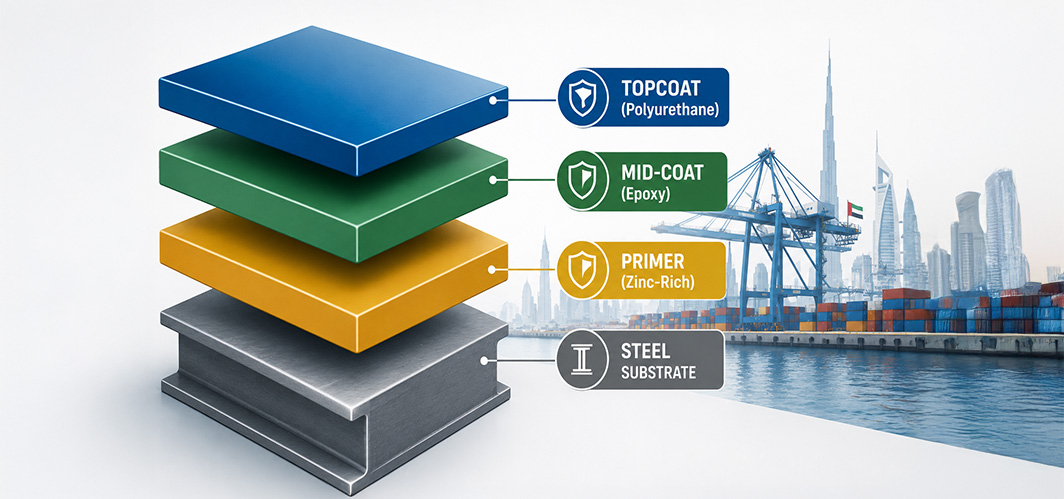
Zinc-Rich Primer Systems: Galvanic Protection as the First Line
Zinc-rich primers provide sacrificial protection by corroding preferentially to the steel substrate. Inorganic zinc silicate (IZS) primers offer the highest level of galvanic protection and are commonly specified for marine structural steel with design lives exceeding 20 years. They require stringent surface preparation, often Sa 2.5 or Sa 3, and tight control of application conditions.
Organic zinc epoxy primers are more tolerant of application variables and are easier to repair, but they generally provide lower long-term galvanic performance than IZS systems.
High-Build Epoxy Mid-Coats: The Barrier Layer
High-build epoxy coatings form the primary barrier against moisture and chlorides. Typical dry film thickness (DFT) ranges from 100 to 200 microns per coat, depending on the specification and exposure zone.
Under-application is a common cause of premature failure, as thin areas become the first points of moisture ingress. ASSENT STEELS verifies DFT using calibrated gauges to ensure coating systems meet specified thickness requirements.
Polyurethane vs. Epoxy Topcoats
- Aliphatic polyurethane: UV stable and colour-retentive, making it the standard topcoat for exposed marine steelwork.
- Aromatic polyurethane: More economical, but chalks more quickly under sunlight.
- Epoxy topcoat: Suitable for submerged or sheltered areas where UV resistance is not required.
- Fluoropolymer or PVDF coatings: Used where extended aesthetic performance and very long service life are required.
Specialist Systems for Splash Zone and Immersion Service
- Glass flake epoxy: Provides excellent resistance to osmotic blistering and mechanical damage in splash-zone conditions.
- Modified epoxy or coal tar-free immersion systems: Widely specified for submerged steel and piling.
- Coal tar epoxy (where permitted): Historically used for immersion service, though increasingly replaced by lower-PAH alternatives.
- Thermal spray aluminium or zinc (TSA/TSZ): Metallic coatings used for highly critical offshore and marine infrastructure requiring very long design life.
The appropriate marine coating system is determined by exposure zone, design life, maintenance strategy, and project specification rather than by coating brand alone.
Coating System Comparison: What to Specify for Marine Steel in UAE
| Coating System | Typical Design Life | Best Fit | Key Limitation | Relevant Standards |
|---|---|---|---|---|
| Inorganic Zinc Silicate + High-Build Epoxy + Polyurethane | 20–25 years | Coastal atmospheric structural steel | Requires high-quality surface preparation | ISO 12944 C5-M, NORSOK M-501 |
| Organic Zinc Epoxy + Epoxy + Polyurethane | 15–20 years | General marine atmospheric exposure | Lower galvanic protection than IZS | ISO 12944 C4–C5 |
| Glass Flake Epoxy | 15–20 years | Splash zone and high-abrasion areas | Thick film requires careful handling | ISO 12944 Im2–Im3 |
| Modified Epoxy / Coal Tar-Free Immersion System | 20+ years | Submerged steel and marine piling | Limited colour and finish options | ISO 12944 Im1–Im3 |
| Thermal Spray Aluminium or Zinc (TSA/TSZ) | 30+ years | Offshore and critical infrastructure | Higher application cost | ISO 2063, NORSOK M-501 |
For most coastal structural steel projects in the UAE, the benchmark specification remains an inorganic zinc silicate primer, high-build epoxy mid-coat, and aliphatic polyurethane topcoat. More severe exposure zones such as splash and immersion service require specialised systems designed to resist osmotic blistering, mechanical damage, and cathodic disbonding.
What Coating Standards Govern Marine Steel Protection in UAE and Gulf Projects?
Marine coating specifications in the UAE and wider Gulf region are tyically governed by a combination of international corrosion protection, surface preparation, and offshore standards. These standards define the required surface cleanliness, coating system build-up, and expected service life.
- ISO 12944 (Parts 1–9): The primary international standard for corrosion protection by protective coating systems. It defines corrosivity categories, including C5-M for marine atmospheric environments and Im1 to Im3 for immersion service.
- NORSOK M-501: Widely referenced in offshore and oil and gas projects. It sets stringent requirements for surface preparation, coating application, and inspection.
- SSPC-SP10 / Sa 2.5: Near-white blast cleaning standard used as the minimum surface preparation level for most marine coating systems.
- ISO 8501-1: Defines rust grades and visual blast cleaning standards, including Sa 1, Sa 2, Sa 2.5, and Sa 3.
- IMO PSPC (MSC.215(82)): Mandatory for ship ballast tanks and increasingly referenced for marine terminals and port infrastructure.
For most UAE coastal and offshore projects, coating specifications are developed around ISO 12944 and NORSOK M-501 requirements, with surface preparation and inspection criteria aligned accordingly.
What are the Most Common Marine Coating Specification Mistakes on UAE Projects?
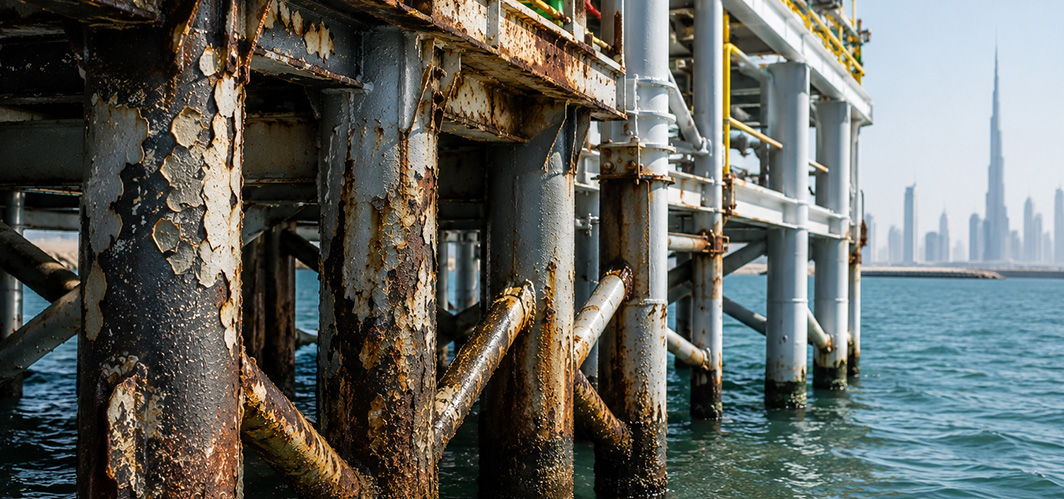
Specifying atmospheric-grade coatings for splash zone or immersion service
Coating systems designed for atmospheric exposure often fail rapidly when exposed to constant wet-dry cycling or full immersion. The result is osmotic blistering, underfilm corrosion, and coating breakdown within a few years.
Accepting Sa 2 when Sa 2.5 is required
Reducing the surface preparation standard leaves residual contamination and mill scale that compromise zinc primer performance. This limits galvanic protection and accelerates coating failure.
Under-specifying dry film thickness (DFT)
Insufficient film build reduces barrier protection and creates thin spots over edges and welds, which are typically the first areas to corrode.
Skipping holiday detection for immersion-service coatings
Even minor pinholes can expose bare steel to seawater, creating concentrated corrosion cells that spread beneath the coating.
Selecting coating systems by brand rather than exposure category and design life
The performance of a marine coating system depends on its suitability for the corrosivity category, service environment, and maintenance strategy, not on product reputation alone.
On UAE coastal projects, where chloride exposure and UV intensity are both severe, specification shortcuts often lead to premature maintenance cycles and significantly higher lifecycle costs.
POV: In the UAE's Marine Environment, Coating Specification Conservatism Always Pays Off
In the Arabian Gulf, corrosion rates leave little margin for optimistic specifications. The cost difference between a standard coastal coating system and a more robust C5-M or NORSOK-compliant system is typically modest when measured against the total project budget. By contrast, premature coating failure on an operational marine asset can trigger access costs, shutdowns, and repainting expenses that far exceed the original coating value. For this reason, ASSENT STEELS often recommends specifying toward the upper end of the performance range for UAE coastal projects, treating coating selection as a lifecycle cost decision rather than a material cost exercise.
Specifying for Service Life, Not Just Initial Cost
Marine coating selection is a systems engineering decision shaped by exposure zone, design life, surface preparation, and compliance requirements. In UAE coastal and offshore projects, small specification compromises can significantly reduce coating life and increase maintenance costs.
ASSENT STEELS supports marine and coastal projects through integrated blasting, painting, and fireproofing capabilities aligned with international coating standards. Explore our steel blasting and painting services or discuss your coating specification with our technical team to evaluate the right system for your project.
Frequently Asked Questions
1. What is the best paint system for steel in a marine environment?

For marine atmospheric exposure, the industry benchmark is an inorganic zinc silicate primer, high-build epoxy mid-coat, and aliphatic polyurethane topcoat. Submerged and splash-zone steel may require glass flake epoxy or modified epoxy systems with cathodic protection. The best system always depends on the exposure zone, design life, and project specification.
2. What ISO standard applies to marine steel coatings?
3. How long do marine steel coatings last?
4. Is zinc primer required for marine structural steel?
5. What surface preparation is needed for marine coating systems?
More Blogs