May 11, 2026
Table of Content
- In-House vs Outsourced Steel Blasting and Painting: Cost, Quality and Timeline Impact
- What Does it Actually Cost to Blast and Paint Steel In-House vs Outsourcing?
- Does Outsourcing Compromise Your Control Over Surface Preparation Quality
- How Does the Blasting and Painting Decision Affect Your Project Timeline?
- When Does In-House Blasting and Painting Make Business Sense?
- What are the Most Common Mistakes When Choosing Between In-House and Outsourced Blasting
- Expert POV: The Fabricator Who Paints In-House Is Often Competing on the Wrong Variable
- Frequently Asked Questions
- Making the Right Coating Decision for Your Project
In-House vs Outsourced Steel Blasting and Painting: Cost, Quality and Timeline Impact
Outsourced steel blasting and painting often delivers better surface consistency, higher throughput, and lower rework risk on large-scale projects. Certified facilities use specialised equipment, controlled application environments, and documented quality systems that many in-house operations cannot economically maintain. For contractors handling variable project volumes, outsourcing frequently reduces total project cost and schedule exposure.
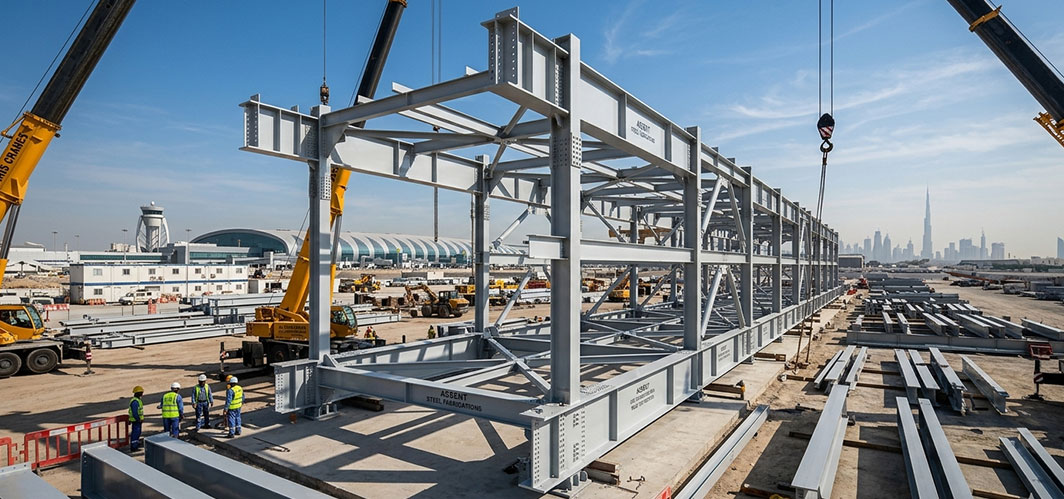
Contractors often assume that keeping steel blasting and painting in-house will reduce project costs. In practice, many discover the opposite after coating failures, rejected inspections, or erection delays caused by inconsistent surface preparation. In the UAE construction sector, where airport expansions, industrial facilities, and data centres demand SSPC and ISO-compliant finishes, coating quality directly affects project handover and warranty performance.
This is not simply a procurement preference between internal and external resources. The decision influences fabrication flow, inspection approval, erection sequencing, and long-term coating durability. Choosing the wrong approach at fabrication stage can create schedule pressure long after steel reaches site.
What Does it Actually Cost to Blast and Paint Steel In-House vs Outsourcing?
| Cost Factor | In-House Operation | Outsourced Facility |
|---|---|---|
| Capital Equipment | AED 2M to 5M+ investment for blasting machines, booths, cranes, and ventilation systems | Included within service scope |
| Manpower and Training | Ongoing NACE or SSPC training costs plus coating inspectors and operators | Certified personnel provided by facility |
| Abrasive Consumables | Managed internally with potential wastage and storage loss | Optimised through controlled blasting systems |
| Quality Failures and Rework | Re-blasting, repainting, and inspection rejection can significantly increase project cost | Reduced through documented inspection processes |
| Environmental Compliance | Additional cost for permits, waste disposal, and dust containment | Managed under approved facility operations |
| Throughput Flexibility | Limited by available booths and manpower | Scalable capacity up to 84,000 m²/month |
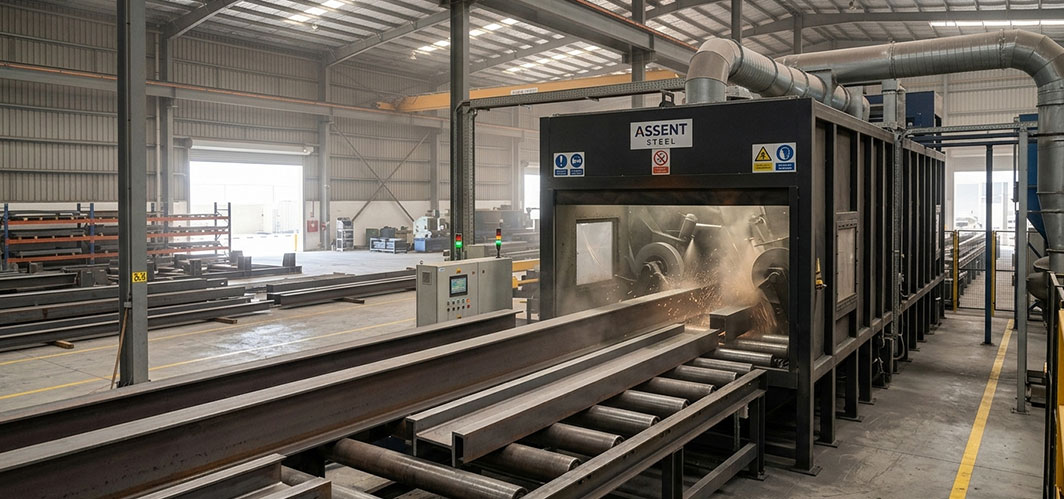
The financial impact changes significantly based on project volume and frequency. A fabricator processing 50 MT of painted steel per month will evaluate cost differently from an operation handling 500 MT or more. In practice, the decision is not simply a quote comparison. It is a calculation based on utilisation, compliance requirements, and the operational cost of delays or coating failures.
Does Outsourcing Compromise Your Control Over Surface Preparation Quality
One of the most common assumptions in steel fabrication is that outsourcing surface preparation reduces quality control. In practice, quality problems are more likely to occur in facilities that lack dedicated blasting infrastructure, controlled application environments, or documented inspection systems.
What Surface Standards Should Your Contractor Be Meeting?
- Sa 2.5 near-white blast cleaning for structural steel applications
- SSPC-SP10 compliance verification before primer application
- Dry Film Thickness (DFT) measurement records for each coating layer
- Holiday or pinhole detection for submerged or high-exposure structures
- Access for third-party inspection and client quality representatives
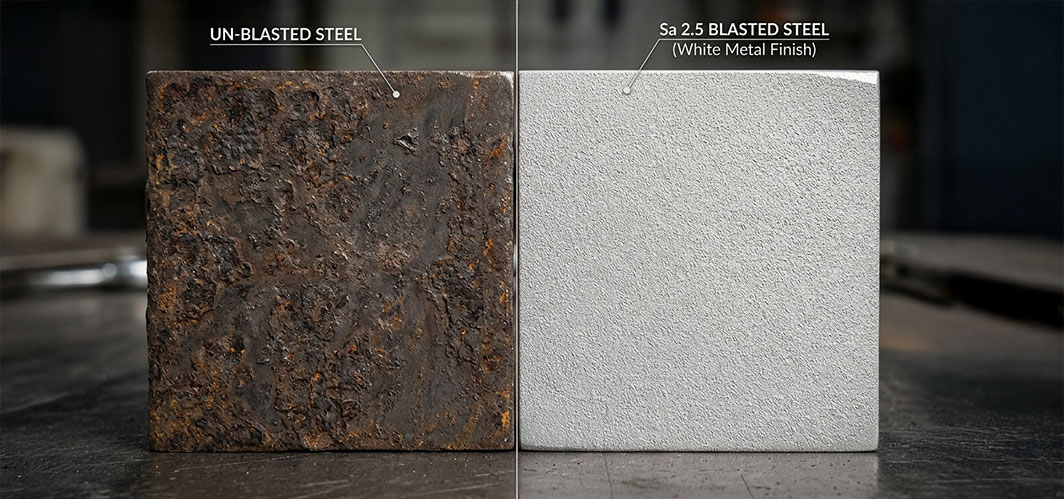
Many in-house operations struggle to maintain consistent blasting and painting conditions, particularly when coating work competes with fabrication activities for space, manpower, and crane access. Variations in humidity control, abrasive quality, and component handling often lead to inconsistent surface profiles and coating performance.
Purpose-built facilities operate differently. ASSENT STEELS’ blasting and painting facility includes covered operational areas, automatic blasting systems, multiple painting bays, manual booths, and roller conveyor handling systems designed for continuous throughput and controlled application quality. This type of setup enables coating work to progress alongside fabrication without creating operational bottlenecks.
How Does the Blasting and Painting Decision Affect Your Project Timeline?
Where Painting Becomes a Critical Path Item
Consider a 1,200-tonne structural steel package for a commercial tower in Dubai. Fabrication may finish on schedule, but limited blasting and painting capacity can delay dispatch, affecting erection sequencing and crane bookings on site. In many projects, coating becomes the bottleneck rather than fabrication itself.
An in-house setup operating with two painting booths can quickly reach capacity limits when specifications change or accelerated schedules are introduced. Delays compound further if rework or re-blasting becomes necessary. By comparison, a dedicated facility with high-volume throughput capacity can continue processing steel in parallel with fabrication, reducing the risk of programme disruption.
What Causes Painting-Related Delays on Steel Projects?
Painting delays are often underestimated during procurement planning, yet they directly affect steel release, transport scheduling, and installation progress once erection begins.
When Does In-House Blasting and Painting Make Business Sense?
In-house blasting and painting can be commercially viable under specific operating conditions. The decision generally depends on production continuity, available infrastructure, and the level of coating control required across projects.
| Scenario | Recommended Approach |
|---|---|
| One-off or seasonal fabrication volumes | Outsource for flexibility without capital investment |
| Continuous output above 3,000 MT/month | In-house operation may become commercially efficient |
| Existing ISO-certified blasting and painting facility | In-house model can support greater process control |
| Marine or offshore coating specifications | Specialist outsourced facility often preferred |
| Multiple coating systems across project packages | Outsourcing simplifies coordination and compliance |
| Accelerated erection schedules with parallel fabrication | Outsourcing provides higher throughput scalability |
For many contractors and fabricators, the decision is operational rather than theoretical. Maintaining certified coating systems, trained inspectors, environmental compliance, and scalable throughput requires sustained utilisation levels that smaller or variable-volume operations may not achieve consistently.
What are the Most Common Mistakes When Choosing Between In-House and Outsourced Blasting
Comparing hourly rates instead of total project cost
Lower hourly coating rates can appear attractive during procurement, but rework, inspection rejection, delayed erection, and extended site timelines often create significantly higher downstream costs. Evaluating total project impact provides a more accurate comparison than labour or booth rates alone.
Assuming every blasting facility can handle all coating systems
Different coating specifications require different application controls, inspection procedures, and environmental conditions. Facilities experienced with basic commercial coatings may not be equipped for offshore, industrial, or fireproofing systems with tighter compliance requirements.
Awarding work without verifying certification and inspection capability
ISO and SSPC compliance should be validated before award, not after production begins. Procurement teams should confirm inspection procedures, DFT reporting, and third-party access capability during technical evaluation.
Ignoring environmental and waste management obligations
Blasting and painting operations generate dust, waste abrasives, and chemical residues that require controlled handling. Non-compliant facilities can expose contractors to operational and regulatory risk.
Treating coating as a final activity rather than a schedule driver
Painting directly affects steel release, transport planning, and erection sequencing. Delays at coating stage often cascade into installation and commissioning activities later in the programme.
Expert POV: The Fabricator Who Paints In-House Is Often Competing on the Wrong Variable
Many fabricators treat in-house blasting and painting as a competitive advantage because it appears to provide greater control over cost and scheduling. In reality, the more important differentiators in the UAE construction sector are certified quality systems, throughput scalability, and consistent compliance with international coating specifications.
Projects involving airport infrastructure, industrial facilities, and multinational EPC contractors increasingly require documented SSPC and ISO-controlled processes that smaller in-house setups struggle to maintain efficiently. A purpose-built blasting and painting facility is not simply a production asset. It is an operational system designed to reduce inspection risk, maintain schedule continuity, and support large-scale project execution.
Making the Right Coating Decision for Your Project
The decision between in-house and outsourced blasting and painting affects far more than coating cost alone. Production volume, specification complexity, inspection requirements, and erection timelines all influence which approach delivers better project outcomes.
For many contractors and fabricators, the priority is not simply where coating happens, but whether the process can consistently meet quality, compliance, and schedule expectations. ASSENT STEELS supports these requirements through integrated blasting and painting capabilities designed for large-scale structural steel projects across the UAE and GCC.
Explore our blasting and painting services or request a coating specification review to evaluate the right approach for your next project.
Frequently Asked Questions
1. Is outsourced steel blasting and painting more expensive than in-house?

Not always. When equipment investment, compliance costs, manpower, inspection risk, and rework are considered, outsourcing is often more cost-effective on a total-project basis. For example, a contractor processing occasional steel volumes may avoid significant capital and maintenance costs by using a certified external facility.
2. What surface preparation standard is required for structural steel in the UAE?
3. How do I evaluate a steel blasting and painting subcontractor in Dubai?
4. Can outsourced blasting and painting meet project-specific coating specifications?
More Blogs