August 18, 2026
What are the steps in the steel fabrication process?
The steel fabrication process moves through design and engineering, material procurement, cutting and CNC processing, welding and assembly, surface treatment, quality inspection, and finally delivery to site. Each stage depends on the accuracy of the one before it, which is why sequencing and handoffs matter as much as the work itself.
A procurement team awards a steel package, a purchase order is signed, and a delivery date gets pencilled into the master programme. What actually happens between that purchase order and steel arriving on site is often unclear, which leads to unrealistic timeline assumptions and friction the moment any single stage takes longer than expected. On a UAE mega-project programme, where one fabrication delay cascades directly into crane bookings and erection sequencing, that gap in understanding is expensive. This post walks through the real workflow stage by stage, not a marketing, not a marketing description of it.
Steel Fabrication Process at a Glance
- Design and engineering intake (shop drawings, 3D modelling)
- Material procurement and mill certification
- Cutting and CNC processing
- Welding and assembly
- Blasting and surface preparation
- Painting and protective coating
- Quality control and inspection
- Packing, logistics, and delivery to site
1.Design and Engineering Intake
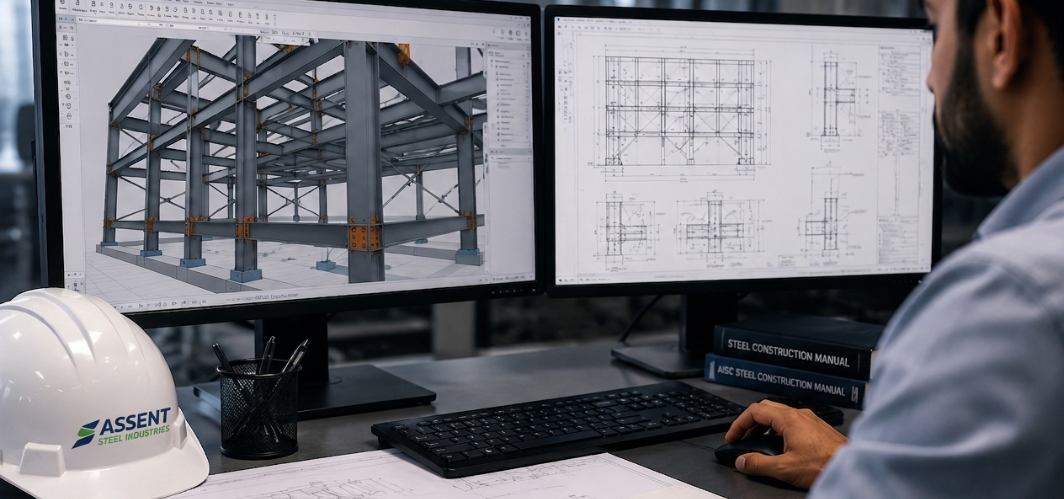
Before any steel is touched, the fabricator reviews the issued-for-construction (IFC) drawings and produces shop drawings and 3D models, typically in software such as Tekla or SDS2. This stage translates architectural and structural intent into the exact dimensions, connections, and member details the shop floor will work from, and it is also where any gap between the structural design and the practical realities of fabrication first becomes visible.
Catch a clash or a dimensional error here costs a fraction of what it costs to catch the same error during erection, when steel is already fabricated, coated, and sitting on a crane pick list with a fixed installation sequence around it. RFI turnaround time is a real, measurable differentiator between fabricators at this stage. A team with in-house engineering can resolve a design query against the same drawings they produced, often within a day, while a fabricator relying on an external design consultant is waiting on someone else's queue before work can proceed. That difference alone can shift a project timeline by weeks before fabrication even begins, long before it becomes visible anywhere on the master programme.
2.Material Procurement and Mill Certification
Fabrication starts with sourcing certified structural steel, and the mill test certificate (MTC) is the document that verifies grade, chemical composition, and mechanical properties for every batch delivered to the shop floor. On UAE projects involving international main contractors, traceability back to a certified mill matters for both compliance sign-off and insurance purposes, not just as a paperwork formality that gets filed away and forgotten.
Without a clear MTC trail, a project can face delays at handover stage while certification gaps are chased down retroactively, which is a far worse position than confirming traceability before material is even cut. Long-lead items, heavy plate sections or specialty profiles that are not held in standard stock, are one of the most common causes of early schedule slippage on a fabrication package. If these are not identified and ordered at the very start of the process, the delay shows up weeks later as a fabrication bottleneck that has nothing to do with shop floor capacity or workforce availability.
3.Cutting and CNC Processing
On the shop floor, cutting and CNC processing shape raw material to the tolerances set in the approved shop drawings. This includes CNC plasma or laser cutting, drilling, and profiling, all controlled to dimensional tolerances that determine how cleanly members will fit together later, both against each other and against the connection details produced during engineering. Accuracy at this stage reduces rework downstream at welding and, more critically, at erection, where a misaligned connection is far more disruptive and expensive to fix once steel is in the air on site.
Fabricators without in-house CNC capability sometimes subcontract this step to a third party, which adds another handoff point, another transport leg, and additional lead time to a process that is otherwise entirely sequential. Every subcontracted step introduces a scheduling dependency that sits outside the fabricator's direct control, which is precisely the kind of gap that turns a tight programme into a delayed one.
4.Welding and Assembly
Components are joined according to approved welding procedure specifications (WPS), carried out by welders qualified against recognised standards such as AWS or AISC benchmarks, with qualification records kept on file for each individual welder working on the project. Jigs and fixtures play a significant role here, holding repeated members in consistent alignment so that dimensional accuracy carries through from one unit to the next rather than drifting across a production run of dozens or hundreds of similar members. This stage is where a fabricator's skilled labour capacity, not just the machinery on the shop floor, actually determines throughput and quality.
Two fabricators can own identical equipment and still produce very different welding turnaround and consistency, because the constraint sits with certified welders and supervision, not with the equipment itself. A shop running at full welder capacity with strong supervision will consistently outpace one that has invested more heavily in machinery but is short-staffed on qualified welding personnel.
5.Blasting and Surface Preparation
Before coating can begin, fabricated steel goes through abrasive blasting to achieve the surface cleanliness grade specified for the project, referenced against SSPC or Sa cleanliness standards that define exactly how much surface contamination and mill scale must be removed. The window between blasting and priming is time-sensitive, and this is especially relevant in the UAE's humid coastal climate, where flash rust can begin forming within hours if this step is delayed or handled by a separate vendor outside the fabrication facility.
Once flash rust appears, the blast typically has to be repeated before priming can proceed, adding cost and time that were never accounted for in the original schedule. Surface preparation that happens immediately after fabrication, inside the same production flow and under the same roof, keeps this window under control rather than leaving it dependent on a second company's schedule and transport timing.
6.Painting and Protective Coating
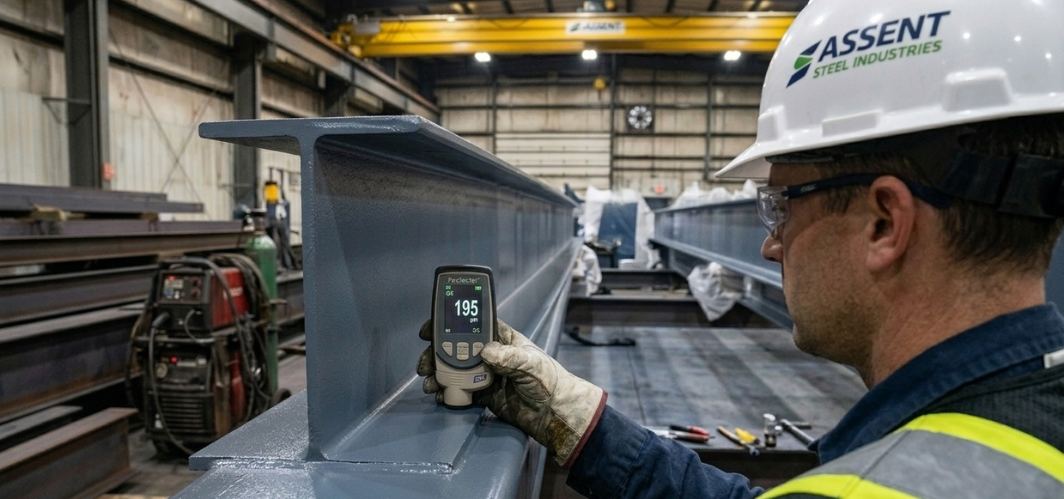
Quality control inspector in a white hard hat and safety vest viewed from the side, using a digital handheld gauge to measure dry film thickness (DFT)
Coating systems for structural steel are typically specified based on the corrosion environment, ranging from epoxy primers and polyurethane topcoats to zinc-rich systems for high-corrosion applications such as coastal or industrial sites where salt air and humidity accelerate degradation. Coating thickness is checked using dry film thickness (DFT) measurements at multiple points across each member, verified against the approved paint specification rather than judged visually, since visual inspection alone cannot confirm whether a coating meets its specified protective thickness.
Depending on project requirements, fireproofing coatings may also be applied at this stage, adding a further layer of specification and inspection before the members are ready to move forward. Getting this stage wrong is rarely visible immediately. Coating failures tend to surface months or years after handover, which is exactly why DFT verification at the time of application matters more than it might seem during a fast-moving fabrication schedule.
7. Quality Control and Inspection
Inspection runs through fabrication as a continuous layer, not a single check at the end of the process. Dimensional checks confirm members match the shop drawings, weld inspection verifies joint integrity against the approved WPS, and non-destructive testing methods such as ultrasonic or magnetic particle testing are applied where the project specification calls for them, typically on critical or highly loaded connections.
Coating DFT verification closes out the surface treatment stage with a documented record rather than a visual sign-off, giving every member a traceable inspection history from raw material through to final coat. What third-party inspectors and main contractors actually request before approving a package is the fabricator's own QC documentation trail, covering every one of these checkpoints, not a single final walk-through at the end of the process that offers no visibility into what happened at each earlier stage.
8. Packing, Logistics, and Delivery to Site
Fabricated members are marked, packed, and sequenced to match the erection programme, not shipped in bulk and sorted out later on site. Phased delivery aligned to site readiness avoids storage and re-handling on an already congested site, where space for staging additional steel is limited. Proximity to major UAE project hubs also affects how reliably delivery windows are met, since shorter, more predictable transport routes reduce the chance of a delivery slipping against a tightly sequenced erection schedule.
Understanding this workflow matters most at the point of awarding a fabrication package. It sets realistic timeline expectations from the outset and gives procurement teams the right questions to ask at each stage, rather than a single lead time figure that hides where the actual risk sits. ASSENT STEELS runs this entire workflow, engineering through delivery, in-house under one production system. Explore the Fabrication services page for more detail, or Request a quote to discuss an upcoming package.
Frequently Asked Questions
1. What are the main steps in the steel fabrication process?

The process runs through design and engineering, material procurement, cutting, welding, surface treatment, quality inspection, and delivery, in that order, with each stage feeding directly into the next.
2. How long does the structural steel fabrication process take?
3. What quality checks happen during steel fabrication?
4. Why does in-house engineering matter in the fabrication process?
More Blogs