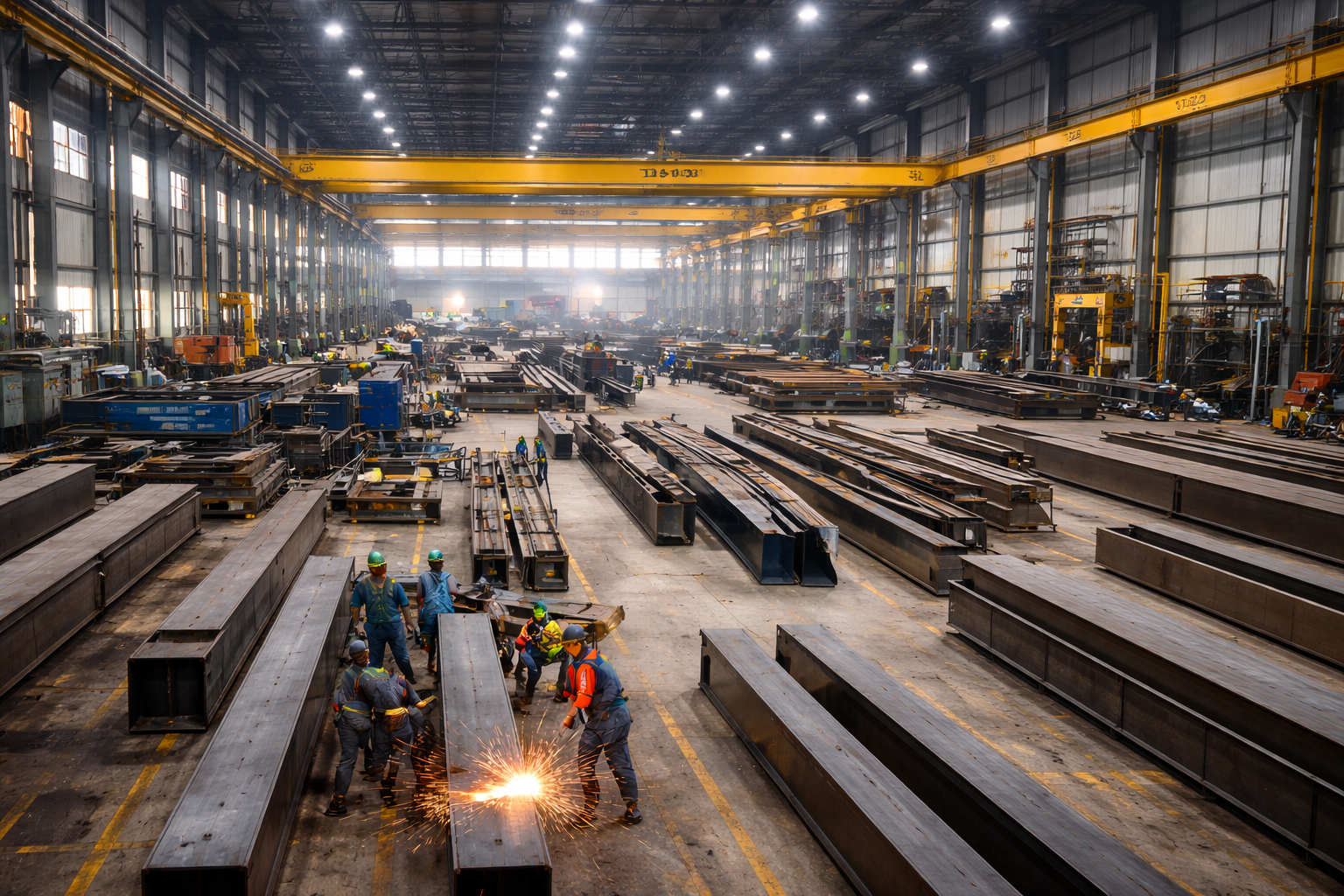
Procurement teams in the UAE often operate under tight project timelines, shifting specifications, and pressure from main contractors to secure capable supply partners quickly. Selecting a steel fabrication company that cannot meet capacity or compliance requirements can lead to delays, rework, and programme disruption. At Assent Steel, we've been on the receiving end of project evaluations for over 15 years across airports, data centres, stadiums, and industrial plants across the UAE and GCC.
This guide provides a clear, practical checklist to help evaluate steel fabricators in the UAE, focusing on measurable criteria that directly impact project performance and delivery outcomes.
Steel Fabricator Evaluation Checklist
Procurement teams can use the following checklist to quickly assess whether a steel fabricator meets the core requirements for UAE construction projects:
- Production capacity meets or exceeds required tonnage per month
- ISO 9001, ISO 3834, and CE marking (EN 1090) certifications in place - with AISC/AWS where specified by the client
- In-house engineering capability using Tekla or SDS2
- Relevant project portfolio within the same sector
- In-house blasting and painting capabilities
- Strong HSE performance with low LTIFR
- Proven track record of on-time delivery
- Pre-qualification documents available and up to date
- UAE local authority approvals (Dubai Municipality / ADCD) confirmed
1. Production Capacity and Facility Scale
Production capacity directly impacts whether a fabricator can sustain output across large or time-critical projects. In the UAE, major developments often require fabricators capable of handling high monthly tonnage without affecting quality or delivery timelines. Contractors should assess both annual capacity and how many projects can run simultaneously without resource constraints.
Covered fabrication space is equally important, as it ensures continuity during extreme weather conditions common in the region.
Key Questions to Ask:
- What is your monthly production capacity in tonnes
- How many projects can you handle at the same time
- What percentage of your production is completed in-house
2. International Certifications and Quality Standards
Certifications are not just formalities; they determine whether fabricated steel will be accepted on site. Project teams should verify ISO 9001 for quality management, CE marking for structural compliance, and AWS D1.1 for structural welding and AISC standards for fabrication practices. AISC certification may also be required where specified by US-headquartered EPC contractors or clients sourcing for North American projects.
ISO 3834, the international welding quality standard, is also widely required across UAE, GCC, and international projects, particularly in oil and gas, infrastructure, and data centre sectors. Procurement teams should confirm whether a steel fabrication contractor holds ISO 3834 certification and at which level, Part 2 or Part 3, as this directly reflects the rigour of their welding quality management system.
Without proper certification, steel deliveries can be held up during inspection, leading to delays, rework, and contractual complications. CE marking under EN 1090 is mandatory for projects in Europe and the UK, and is increasingly requested by international main contractors operating in the UAE and GCC as evidence of controlled factory production.
Key Questions to Ask:
- Which certifications do you currently hold
- Are your processes aligned with CE marking requirements
- Can you provide valid certification documents for verification
- Do you hold ISO 3834 certification, and at which level?
3. In-house Engineering and Design Capability
Not all fabricators provide engineering support. Some rely entirely on external drawings, which increases the risk of coordination gaps and delays during fabrication or erection. Steel Fabricators with in-house engineering teams can review IFC drawings, produce shop drawings, and coordinate 3D models using tools such as Tekla or SDS2.

This capability allows issues to be identified early, reducing RFIs and improving alignment between design, fabrication, and site requirements. Faster turnaround on revisions also helps maintain project momentum.
Key Questions to Ask:
- Do you have an in-house engineering team
- Which software platforms do you use for modelling and detailing
- How do you manage drawing revisions and RFI responses
4. Track Record Across Relevant Project Types
A fabrication company’s past projects should closely match the type of work being procured. Experience in one sector does not automatically translate to another, as different projects require specific load tolerances, erection sequences, and finishing standards.
Assent Steel has delivered across airports, arenas, high-rise towers, industrial facilities, and data centres across the UAE, GCC, and internationally. Notable projects include the Dubai International Airport Expansion (1,500T, Fabrication & Erection), Coca-Cola Arena (5,000T, Supply, Fabrication & Erection), and Abu Dhabi Plaza, Kazakhstan (20,000T, Supply, Fabrication & Erection).
Reviewing sector-specific experience helps reduce execution risk and ensures the fabricator understands the technical and logistical demands of similar projects.
Key Questions to Ask:
- Can you share projects like ours in scope and sector
- What challenges did you encounter on those projects
- Can you provide client references or completion records
5. Surface Treatment Capabilities: Blasting, Painting, and Fireproofing
Surface treatment is often overlooked during procurement, yet it directly affects durability, compliance, and project timelines. When blasting, painting, or fireproofing is outsourced, additional coordination is required, increasing lead time and the risk of quality inconsistencies.
In the UAE, environmental conditions such as humidity and coastal exposure make coating performance critical. Fabrication specialists with in-house surface treatment capabilities can better control application quality and delivery schedules.
Assent Steel's in-house facility at Dubai Industrial City covers blasting, painting, and fireproofing under one roof, applying epoxy, polyurethane, and zinc-rich coating systems to international standards.
Key Questions to Ask:
- Do you perform blasting and painting in-house
- Which coating systems and standards do you support
- Is fireproofing applied internally or through third parties
6. HSE Record and Safety Culture
HSE performance is a key indicator of how a fabrication facility is managed. In the UAE, main contractors often require detailed HSE data during pre-qualification, including Lost Time Injury Frequency Rate and total safe man-hours. A strong safety record reflects disciplined operations, workforce training, and consistent supervision.
Poor HSE performance can indicate deeper operational issues that affect productivity, quality control, and overall project delivery.
Key Questions to Ask:
- What is your current LTIFR and total safe man-hours
- Do you have a documented HSE management system
- How do you monitor and report safety performance
7. Delivery Reliability and Logistical Capability
In the UAE, construction programmes operate on tight site access windows, where delayed steel deliveries can result in crane standby time and disruption to sequential trades. The fabrication partner must be able to plan deliveries in line with installation sequence and coordinate transport efficiently across emirates.
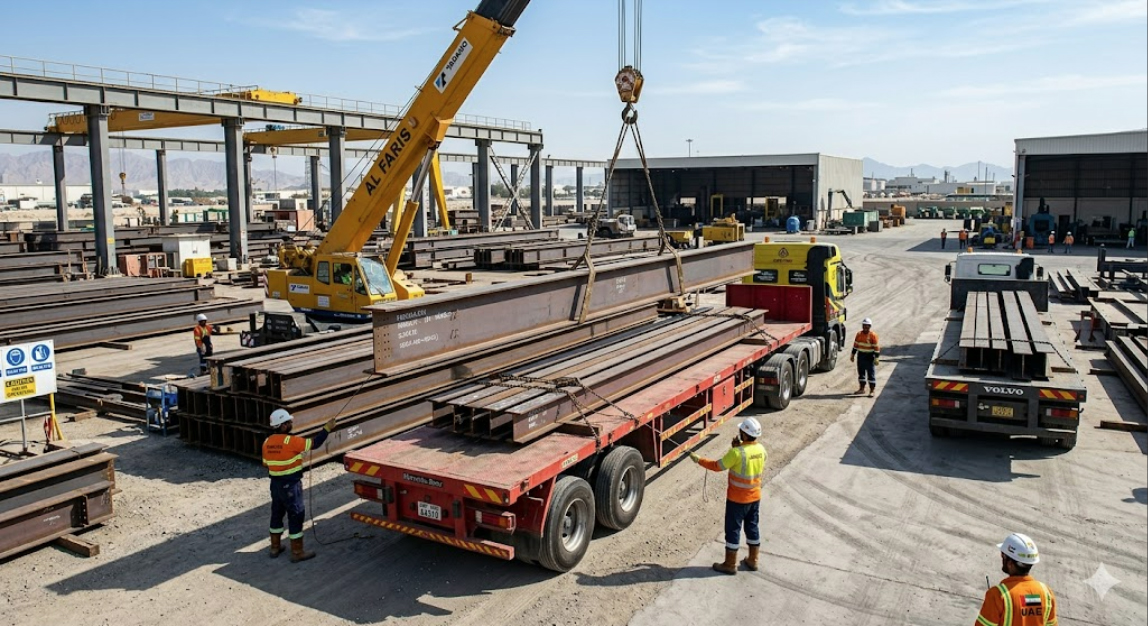
Proximity to project locations and access to organised logistics systems also influence how quickly materials can reach site without delays.
Key Questions to Ask:
- What is your on-time delivery performance rate
- Do you manage logistics in-house or through third parties
- Can you phase deliveries based on site sequence requirements
8. Financial Stability and Pre-Qualification Readiness
Financial stability determines whether a steel fabricator can sustain production throughout the project without disruption. Cash flow issues during execution can lead to delays, reduced output, or incomplete deliveries. Procurement teams should assess financial strength alongside technical capability.
Pre-qualification documents provide visibility into a fabricator’s credentials, including audited financial, insurance coverage, and project history. In the UAE, Tier 1 contractors typically require this level of documentation before awarding contracts.
Key Questions to Ask:
- Can you provide a complete pre-qualification document
- Do you have audited financial statements available
- What level of insurance and bonding capacity do you maintain
Red Flags When Choosing a Steel Fabricator
- Unclear or inflated production capacity claims
- Missing CE marking or incomplete certification records
- Heavy reliance on subcontracted blasting and painting
- No verifiable project references or sector-specific experience
- Slow or inconsistent response to RFIs
- Missing, outdated, or incomplete pre-qualification documents
Making the Right Fabricator Choice for Your Project
Not every steel fabricator will meet all eight criteria, but the more boxes a supplier ticks, the lower the overall project risk. Procurement decisions made at this stage directly influence timelines, cost control, and coordination across the construction programme.
For teams evaluating options in the UAE, focusing on measurable capabilities rather than assumptions helps ensure better outcomes. ASSENT STEEL meets these criteria through integrated operations at Dubai Industrial City, with experience across major projects in the GCC, USA, UK, Africa, Europe and Australia, and over 10 million safe man-hours reflecting strong HSE performance.
Explore our steel fabrication services to get started.
Frequently Asked Questions
What certifications should a steel fabricator in the UAE have?
A steel fabricator serving UAE and international projects should hold ISO 9001 for quality management and ISO 3834 for welding quality assurance. CE marking under EN 1090 is mandatory for projects in Europe and the UK and is widely recognised as a quality benchmark by international contractors globally. AWS D1.1 applies to structural welding across most markets, while AISC certification is typically required by US-based EPC clients. UAE municipality approvals from bodies such as Dubai Municipality or Abu Dhabi City Municipality may also be required depending on the project location.
How do I evaluate a steel fabricator’s production capacity?
Check monthly tonnage output, total facility size, and number of fabrication bays. These factors indicate whether the fabricator can handle project scale and maintain consistent production. Higher capacity also allows flexibility to manage multiple projects without delays.
What is a pre-qualification document (PQD) in steel fabrication?
A PQD is a formal document that includes certifications, audited financials, HSE records, and project history. Main contractors use it to assess whether a fabricator meets project requirements before award. It provides a structured overview of the company’s technical and financial capability.
Why is in-house surface treatment important when choosing a steel fabricator?
Outsourcing blasting and painting increase lead time and quality risks. In the UAE’s coastal and high-humidity conditions, in-house coating ensures better control and compliance with specifications. It also reduces coordination issues between multiple vendors.
