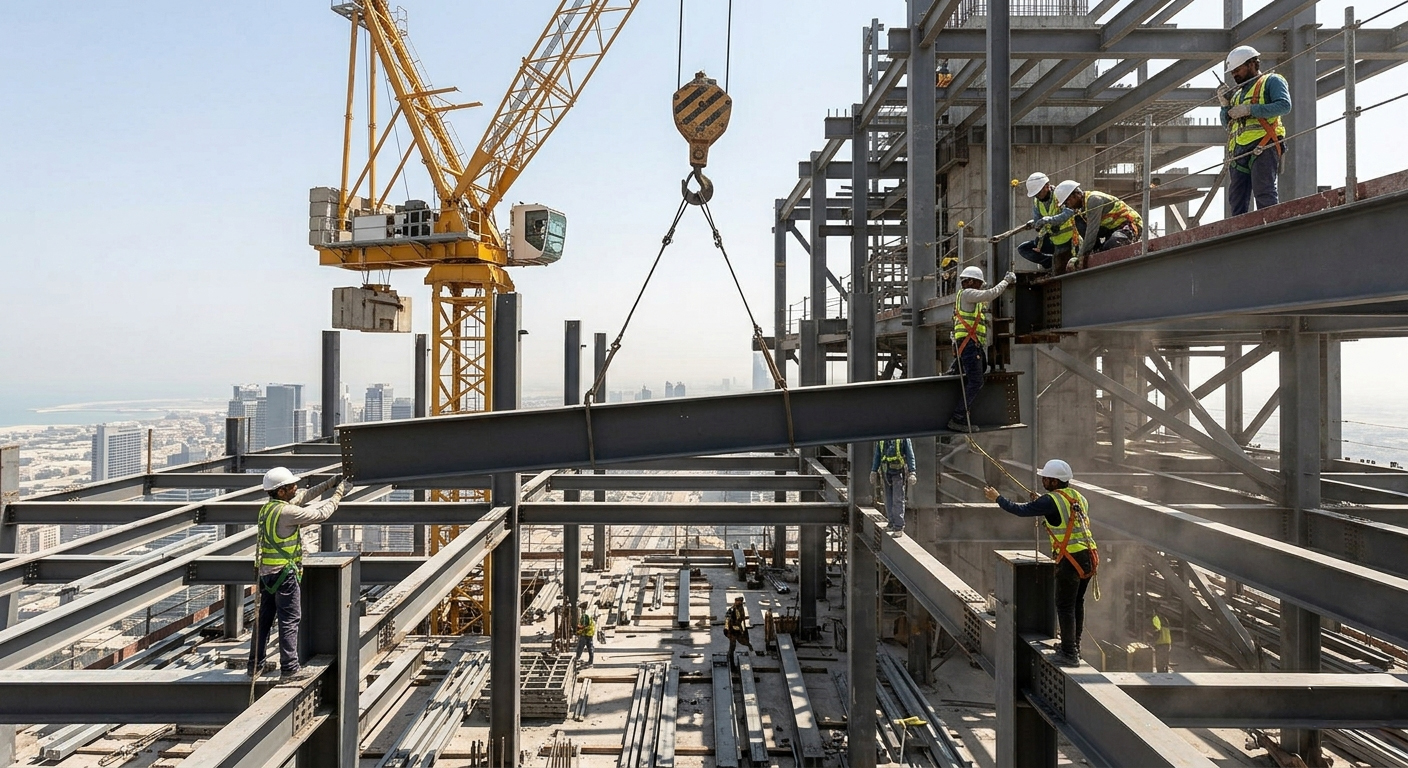
In UAE mega projects, steel erection delays can consume 20-30% of project schedules, often resulting in significant cost overruns and contractual penalties. Structural steel installation is highly visible on site, the real causes of delay usually begin much earlier in the project lifecycle.
For owners and contractors, these delays affect more than timelines. They disrupt coordination between trades, increase labour and equipment costs, and create pressure across the entire construction programme. When steel arrives without proper alignment to design, fabrication, or site conditions, erection teams are forced into reactive work instead of planned execution.
Addressing these challenges early through coordinated engineering, controlled fabrication, structured logistics, and proper site readiness helps ensure smoother installation and more predictable project outcomes.
The Four Root Causes: Where Delays Actually Begin
Steel erection delays rarely originate on site. They are typically triggered by unresolved gaps in planning, coordination, and preparation during earlier project stages. These disruptions typically emerge from gaps in planning, coordination, and preparation across earlier project stages. By the time steel reaches site, these unresolved issues begin to impact progress.
Recognising where delays originate allows project teams to take corrective action earlier. When upstream activities are aligned, erection progresses as planned, with fewer interruptions, reduced rework, and better control over timelines.
Design and Engineering Bottlenecks
Design and engineering gaps are among the leading causes of steel erection delays. Incomplete or uncoordinated engineering information can disrupt sequencing and installation readiness. Erection relies on clear, accurate drawings, and any inconsistencies create uncertainty on site.
Common issues include:
- Mismatches between architectural design drawings and structural fabrication models
- Lack of early clash detection across disciplines
- Incomplete or inaccurate connection detailing
- Delayed issue of approved-for-construction (AFC) drawings
Fabrication and Material Coordination Challenges
Fabrication-stage failures are a hidden but high-impact source of steel erection delays. Issues during fabrication can affect how steel components fit and assemble on site. Delays occur when materials are not prepared in line with project requirements or expected sequence.
Typical challenges include:
- Components not produced in the required order
- Dimensional variations affecting on-site-fit-up and bolt hole alignment
- Missed inspections prior to dispatch
- Insufficient material traceability documentation
Logistics and Delivery Sequencing Problems
Poor delivery sequencing is one of the most preventable yet frequently overlooked causes of erection disruption. Unstructured delivery planning can lead to inefficiencies during material handling and installation. Steel must arrive in the correct sequence to support continuous progress.
Key problems include:
- Deliveries not aligned with erection sequence
- Mismatch between delivery timing and site conditions
- Limited planning for unloading and storage
- Lack of a just in time (JIT) delivery schedule coordinated with the erection contractor
Site Readiness and Infrastructure Delays
Inadequate site readiness is a frequently underestimated delay factor, one that halts erection even when steel is fabricated and delivered on schedule. Site readiness directly determines whether installation can proceed. Without proper preparation, erection activities cannot progress as planned.
Common site-related issues include:
- Incomplete substructure or anchor bolt alignment issues
- Restricted access or inadequate storage areas
- Unprepared crane positions or lifting zones
- Unresolved utility conflicts or overhead obstructions within the erection envelope
Steel Erection Delay Causes vs. Prevention Strategies: A Comparison
Understanding delay triggers is only part of the solution. The real value lies in identifying how each issue can be addressed before it affects site progress. The table below maps common delay causes to their project impact and the prevention strategies applied by ASSENT STEEL.
| Delay Cause | Impact on Project | Prevention Strategy | ASSENT STEEL Approach |
|---|---|---|---|
| Incomplete design | Sequencing confusion | Early 3D modelling and coordination | Engineering coordination at early stages |
| Fabrication mismatches | On-site rework | Strict quality checks before dispatch | CNC precision and QA processes |
| Delivery misalignment | Site congestion | Planned delivery sequence aligned to erection | Coordinated fabrication and logistics |
| Lack of site readiness | Idle labour and delays | Pre-erection readiness checks | Collaborative planning with project teams |
| Weather and external disruptions | Work stoppages and programme slippage | Contingency scheduling and covered storage planning | Proactive programme risk reviews |
This structured approach helps project teams move from reactive problem-solving to proactive planning, reducing uncertainty during erection and improving overall programme control.
Step by Step Best Practices to Avoid Steel Erection Delays
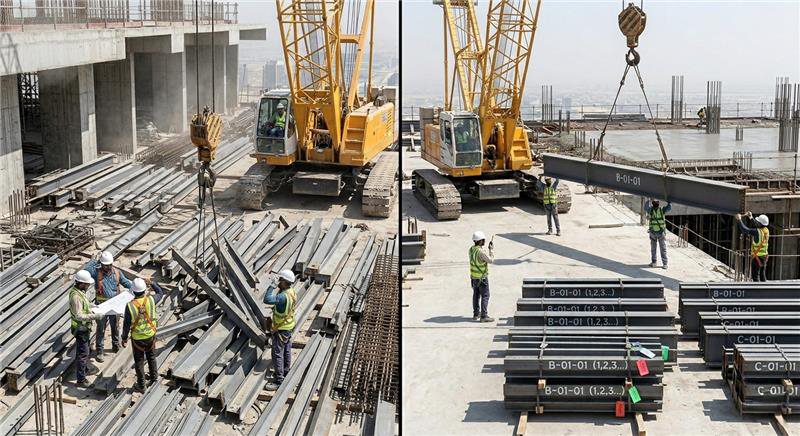
Avoiding delays requires coordinated action across all project stages. When planning, production, and site activities are aligned, erection progresses with fewer disruptions and better control over timelines.
Step 1: Early Engagement and Collaborative Planning
Engage the steel fabricator during the early design phase to align engineering with construction requirements. The earlier a steel fabricator is engaged, the greater the opportunity to resolve design and sequencing issues before they reach site.
- Involve fabrication teams during design development
- Align engineering details with erection sequence
- Use BIM coordination to identify clashes before production
Step 2: Integration of Engineering, Fabrication and Logistics
Coordination between steel engineering, fabrication, and delivery ensures that materials reach site in the correct order and at the right time. This reduces handling issues and supports continuous erection progress.
- Plan delivery based on erection sequence
- Align fabrication timelines with site requirements
- Use real-time material tracking systems to monitor material movement from workshop to site
Step 3: Quality Control and Pre-Dispatch Verification
Pre-dispatch quality control is the last line of defence against on-site delays caused by non-conforming steel components. Inspection and documentation play a key role in ensuring readiness.
- Conduct dimensional and weld inspections prior to dispatch
- Verify surface coatings and protective treatments meet project specifications
- Provide complete inspection documentation and material test reports (MTRs) for site teams
Step 4: Enhanced Site Preparation and Safety Protocols
Site preparation should be treated as a prerequisite to steel erection, not a parallel activity. Ensuring that all infrastructure and safety requirements are in place prevents unnecessary interruptions.
- Confirm foundations, anchor bolts, utilities, and access areas are ready and surveyed
- Conduct pre-erection coordination meetings with erection contractor, civil team, and safety officer
- Plan crane positioning, load charts, and lifting zones in advance
The Real Cost of Steel Erection Delays: Financial Impact Analysis
Delays in steel erection have direct and indirect financial consequences that impact overall project performance. When timelines shift, resources remain engaged longer than planned, increasing both site and project-level costs.
In UAE construction, where mega-project contracts often include liquidated damages (LDs) clauses, even minor erection delays can trigger significant contractual penalties in addition to direct cost increases.
Key cost impacts include:
- Extended crane rental costs: Equipment remains on site beyond planned durations, increasing daily operational expenses
- Labour standby and remobilisation: Idle crews and repeated mobilisation lead to inefficiencies and higher workforce costs
- Re-inspection and permit rescheduling: Additional inspections and approvals add time and administrative expenses
- Disruption to project cash flow: Delays affect billing cycles, financing structures, and overall project liquidity
- Impact on downstream activities: Delayed erection affects subsequent trades, leading to cascading schedule and cost implications
- Liquidated damages (LD) exposure: Contractual penalty clauses triggered by programme slippage can result in financial deductions from contractor payments
Addressing these risks early through coordinated planning helps control costs and maintain project timelines.
Real World Examples: How Assent Steel Prevents Erection Delays
On complex projects, avoiding delays depends on early coordination between engineering, fabrication, and site execution. ASSENT STEELS applies an integrated approach combining in-house engineering, CNC fabrication , and structured logistics to address delay risks at every stage before they reach site.
On large-scale developments, detailed structural modelling and connection design help reduce on-site adjustments. Fabrication outputs are aligned with erection sequencing, ensuring components arrive ready for installation with full quality documentation.
For industrial and infrastructure projects, structured logistics planning supports phased delivery in line with site requirements. This reduces handling time, avoids congestion, and enables continuous erection progress.
These practices demonstrate how coordinated planning and controlled execution help maintain schedules and reduce disruption during installation.
Steel Erection Success Starts with Preparation
Steel erection performance is shaped long before installation begins. When engineering, fabrication, logistics, and site preparation are aligned, erection progresses with fewer interruptions and greater control over timelines.
For project owners and contractors, focusing on early coordination reduces uncertainty, limits rework, and helps maintain cost and schedule targets. A structured approach across all stages ensures that steel arrives ready for installation, supporting efficient execution and overall project success.
