November 17, 2026
Table of Content
- What is coal tar epoxy, and how is it different from standard epoxy?
- Coal tar epoxy vs epoxy: what are the key differences?
- Where is coal tar epoxy still used on steel?
- Why are specifications moving to coal tar-free epoxy?
- Which immersion coating should you specify for steel in the GCC?
- What surface preparation and checks do immersion coatings need?
- Choosing Between Coal Tar Epoxy and Epoxy for Immersed Steel
- Frequently Asked Questions
Older specifications in the Gulf still call for coal tar epoxy on immersed and buried steel, while many newer ones ask for a coal tar-free epoxy. A specifier or contractor then has to decide which is right for the structure. This guide compares coal tar epoxy vs epoxy for steel in seawater immersion and buried service, explains why specifications are changing, and shows how to choose by exposure zone. It builds on our guide to marine coating systems for steel and stays with steel throughout.
What is coal tar epoxy, and how is it different from standard epoxy?
Coal tar epoxy is a two-part epoxy resin blended with coal tar pitch, which gives a dark, thick, water-resistant film. Standard epoxy is a two-part epoxy with no tar, made in many colours. The tar is what separates them, and it changes how the coating looks, behaves and is regulated.
Coal tar epoxy: two-part epoxy resin blended with coal tar pitch, usually black or dark red, applied in thick coats. As a coal tar epoxy coating for steel, it has a long record on piles and buried steel.
Standard epoxy: two-part epoxy with no tar, available in many colours, and often used as a primer or mid-coat in a full coating system.
Coal tar-free epoxy: the tar is replaced with a hydrocarbon resin. It works like coal tar epoxy without the coal tar.
Coal tar epoxy vs epoxy: what are the key differences?
The main differences are tar content, colour, UV behaviour and health limits. Coal tar epoxy gives a thick film in one or two coats and handles seawater well, but it chalks in sunlight and is restricted in many specifications. Standard epoxy suits primers and mid-coats, and coal tar-free epoxy matches coal tar epoxy for immersion without the tar.
In practice, the choice is rarely about which coating resists water best, because coal tar epoxy and coal tar-free epoxy both perform well in immersion. It is about UV exposure, overcoating, health limits and what the specification permits.
The table compares the three types. DFT figures are typical ranges only, so always follow the manufacturer's data sheet.
| Property | Coal tar epoxy | Standard epoxy | Coal tar-free epoxy |
|---|---|---|---|
| Made of | Epoxy resin and coal tar pitch | Epoxy resin, no tar | Epoxy resin and hydrocarbon resin |
| Colour | Black or dark red | Many colours | Several, including light colours |
| Immersion resistance | Very good | Good, if rated for immersion | Very good |
| UV resistance | Low, chalks and fades | Low, needs a polyurethane topcoat in sun | Low, not for sunlit surfaces |
| Typical DFT per coat (per data sheet) | 200 to 400 µm | 50 to 300 µm, by role | 200 to 400 µm |
| Overcoating | Limited window, tar can bleed through | Set by data sheet | Set by data sheet, no tar bleed |
| Health and regulation | Contains coal tar pitch (PAHs), restricted in many specifications | No coal tar | No coal tar |
| Typical use | Piles, buried steel, intake and outfall steel | Primer or mid-coat; immersion-grade (solvent-free) versions for submerged and buried steel. | Immersion and buried steel |
Where is coal tar epoxy still used on steel?
Coal tar epoxy is still used on steel piles and sheet piling, buried steel, intake and outfall structures, and the inside of tanks that do not hold drinking water. It is chosen for a thick, water-resistant film in one or two coats. It does not suit sunlit surfaces, drinking water contact or coloured finishes.
It is chosen for four reasons:
- Low cost compared with many alternatives
- A thick film in one or two coats
- Good water resistance
- Some tolerance of imperfect surfaces
It should not be used on:
- Anything in sunlight, because it chalks and fades
- Surfaces in contact with drinking water
- Any surface that needs a coloured finish
Its thick film also tolerates minor surface imperfections better than thinner coatings. Some specifications still allow coal tar epoxy, and where the specification calls for it, it remains a proven option.
Why are specifications moving to coal tar-free epoxy?
Specifications are moving to coal tar-free epoxy because of health, regulation and practical limits. Coal tar pitch contains polycyclic aromatic hydrocarbons (PAHs) and is classified as a human carcinogen by the IARC. These coal tar epoxy disadvantages affect the crew applying it, waste disposal and later maintenance.
- Health: PAH exposure affects applicators, and tar-containing waste needs controlled disposal.
- Regulation: coal tar pitch is restricted under EU REACH, and many oil and gas and government specifications no longer allow it.
- Practical: it is hard to overcoat later, the tar can bleed through topcoats, and a black-only finish makes defects harder to spot.
A coal tar free epoxy keeps the immersion performance without these limits. Specifications that exclude coal tar often name coal tar-free or solvent-free epoxy as the replacement, so contractors can change system without changing the zone-by-zone approach. Follow the specification your project uses, because some still allow coal tar epoxy.
Which immersion coating should you specify for steel in the GCC?
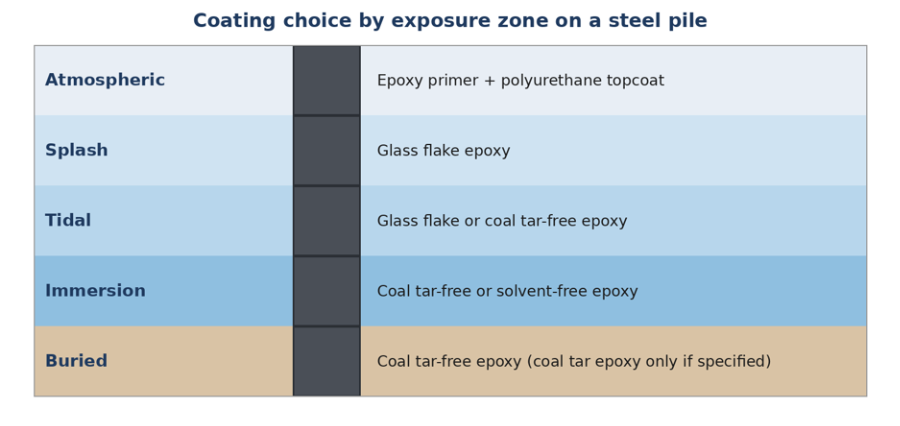
Choose an immersion coating for steel by exposure zone, not by product name. For most new GCC work, a coal tar-free or solvent-free epoxy suits full immersion and buried steel, and glass flake epoxy suits the splash zone. An epoxy coating for submerged steel must also follow what the specification allows.
ISO 12944-2 sets immersion categories Im1 to Im3, with Im4 for seawater where cathodic protection is fitted, and ISO 12944-9 covers offshore structures. A pile sees different conditions from top to bottom: UV in the air, wave action and abrasion in the splash zone, water absorption under immersion, and soil stress when buried. Common choices by zone are:
- Full seawater immersion: coal tar-free or solvent-free epoxy
- Buried steel: coal tar-free or solvent-free epoxy, which applies as a thick film with little shrinkage
- Splash zone: glass flake epoxy
- Coal tar epoxy: only where the client's specification still allows it
If the structure has cathodic protection, the coating must be compatible with it, so ask for cathodic disbondment test data. Gulf conditions add three factors: warm, very salty seawater, high temperatures during application, and short overcoating windows. For wider system choices, see the best coating system for steel in marine environments.
What surface preparation and checks do immersion coatings need?
Immersion coatings need abrasive blasting to Sa 2½ (ISO 8501-1), a soluble salt test before coating, and DFT and holiday checks on every coat. Surface contamination and pinholes are common causes of early immersion failure, so these checks matter as much as the choice of coating.
- Blasting: Sa 2½ with the surface profile the data sheet requires.
- Soluble salts: test to ISO 8502 before coating. This matters near the Gulf coast, where chloride contamination is common, and the limit is lower for immersion than for atmospheric service.
- DFT: measure to ISO 19840 against the specified range. Too little film shortens coating life, and too much can cause cracking or trapped solvent.
- Holiday testing: spark test every immersion coat, because one pinhole can let corrosion start.
The reasons behind this are covered in why blasting before painting matters. Steel blasting and painting services in UAE at ASSENT STEEL run at a painting capacity of 84,000 m² per month.
Choosing Between Coal Tar Epoxy and Epoxy for Immersed Steel
The coal tar epoxy vs epoxy decision comes down to exposure zone and what the specification allows. For most new GCC immersion work, that means a coal tar-free epoxy, with glass flake epoxy in the splash zone. For the wider project picture, see structural steel construction in the UAE. To discuss a coating scope, request a quote.
Frequently Asked Questions
1. What is coal tar epoxy used for?

Coal tar epoxy is used on immersed and buried steel such as piles, sheet piling, intake and outfall structures, and the inside of non-potable tanks. It forms a thick, water-resistant film in one or two coats.
2. Is coal tar epoxy banned?
3. Is coal tar epoxy suitable for seawater immersion?
4. Can coal tar epoxy be used on steel exposed to sunlight?
5. What is the best alternative to coal tar epoxy for submerged steel?
6. What surface preparation is needed before applying coal tar epoxy?
More Blogs